


Connect Golden Gate sandstone landscapes with a northern Drakensberg stay, allowing separate full days, the correct entrances and current access checks.
Planning a South African Family Road Trip for Mixed Ages
Posted on Tue November 3, 2026.

Build a self-drive holiday around the actual needs of children, adults and grandparents: fewer moves, suitable vehicles, confirmed rooms and flexible days.
A South African family road trip with several generations works best when the driving, rooms and daily choices fit the people travelling. A route that looks balanced on a map can feel very different to a child in the back row, an adult doing all the driving or someone who needs a shorter walk and regular rest.
Begin with those differences, then choose the destinations. The aim is a holiday with enough shared experiences to feel like a family trip and enough flexibility for people to enjoy a day at different paces. Adding more places is rarely the first solution to an itinerary that already feels crowded.
Featured photograph: South African road-trip photograph, August 2014. Olivier Flambeau, Wikimedia Commons, CC BY-SA 4.0. Resized and cropped, shared under the same licence. General travel context; no exact location, current road condition or family suitability is implied.
Agree what the whole group needs before drawing a route
Ask each household for one experience it most wants, one practical requirement and one thing it would rather avoid. Wildlife might be a shared priority; climbing steps, long drives or changing accommodation every night might be the real constraint. Keep requirements separate from preferences so that an essential room arrangement does not compete with an optional scenic detour.
Talk directly about the amount of time each person is comfortable spending in a vehicle and how much walking they want. Do not infer those answers from age. An energetic grandparent and a teenager who dislikes hiking may need different arrangements from the stereotypes suggested by a family brochure.
Where health or mobility affects the holiday, seek individual professional advice and describe practical requirements to providers. A travel article cannot decide someone's fitness for an activity.
Choose fewer bases, then protect the transfer days
Count accommodation moves as well as kilometres. A move includes packing, loading, checking out, driving, stops, finding the next property and settling in. A short-looking road section can occupy much of the usable day when several people are involved.
Choose a small number of bases from which your priority activities can be reached. Compare the cost of a longer stay with the effort of repeatedly moving everyone. If the trip has only enough time for one region comfortably, a second region should earn its place through something the family particularly wants.
For example, a family choosing a coastal stage and an Addo safari stage should give each its own stay and put the journey between them on the calendar. This is a planning illustration, not a ready-made national itinerary or a claim that any two coastal bases have the same driving time. Check the actual endpoints before booking.
Test the vehicle against people, bags and entry
A seat count alone is not enough. Avis's South African fleet page shows that vehicles with similar passenger capacity can have different luggage capacities, and says that listed models are representative unless otherwise stated. Discuss your group and bags with the rental company rather than assuming a familiar model will be supplied.
Ask how much luggage space remains with every required seat in use, which row is reached by folding another seat, and whether anyone will find that arrangement awkward. Include mobility equipment, pushchairs and larger bags in the discussion. Two vehicles may offer flexibility, but they also need authorised drivers, separate costs and an agreed meeting plan.
Avis's child-seat information asks renters to request seats when booking and states that its staff are not permitted to install them. Confirm the exact equipment and fitting responsibilities with your provider. Use the manufacturer's instructions and appropriate advice rather than treating a general age description as a fitting assessment for your child.
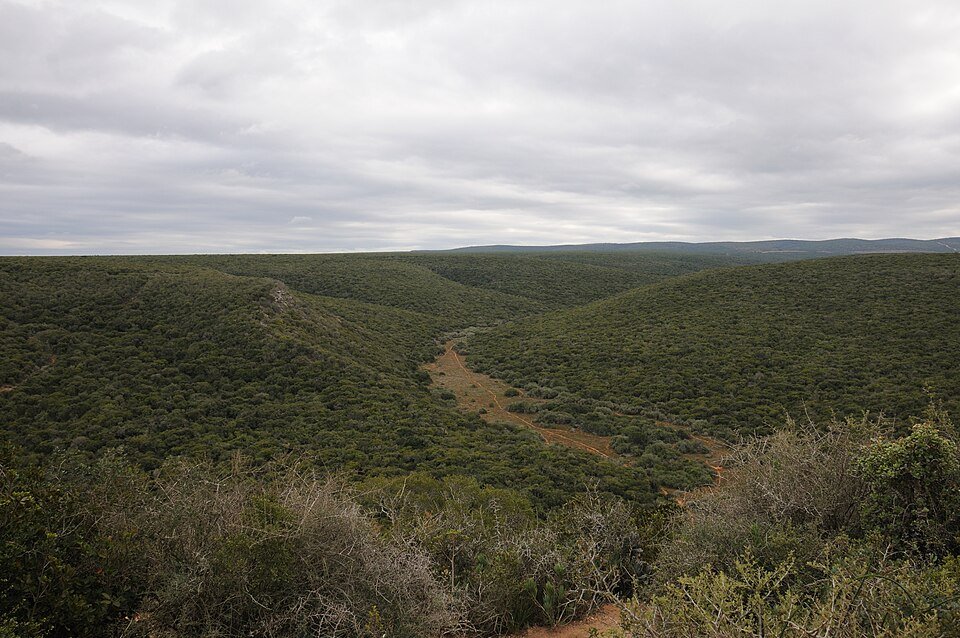
Addo Elephant National Park landscape, August 2017. Josep M. Gracia, Wikimedia Commons, CC BY-SA 4.0, unmodified web reproduction. An example destination, not a prescribed route, current-condition report or wildlife guarantee.
Check the activity format, not the family-friendly label
At Addo, SANParks distinguishes self-drive viewing, guided game drives and hop-on guides who travel in visitors' own vehicles. Its organised game drives exclude children under six. That restriction concerns those drives; it should not be turned into a statement that every safari format has the same age rule.
For a group with different needs, ask what time an activity starts, how long it lasts, whether it can be shortened and who needs to accompany younger travellers. Compare those answers before paying. A shorter self-drive outing and a fixed guided departure are different commitments, even at the same destination.
Addo's access information identifies particular accommodation types and facilities, including a Discovery Trail loop and viewing facilities in the main camp. Ask about the exact unit, current approach and facilities required by your party. An accessible feature in one part of a park does not establish access everywhere.
Build a shared day with an optional extension
Choose one main shared outing, then decide what can be optional. Some people might want a longer walk while others return to their accommodation or stay at a confirmed visitor facility. Arrange the transport and supervision first; the option is only useful if nobody is left waiting without a practical plan.
On a Garden Route stage, for example, SANParks describes shorter circular walking options at Garden of Eden, distinct from longer forest walks. Use a specific route enquiry to match the outing to your group, with current conditions and access confirmed. A national park containing a long hike does not mean every visitor must do it.
Leave some afternoons uncommitted. Agreeing to split up occasionally can give the shared dinner more energy than requiring everyone to complete the same sequence of stops.
Confirm rooms and costs as carefully as attractions
Request the actual sleeping layout, bathroom arrangement, steps and parking-to-room access. A family unit may contain a sleeper couch rather than a separate bedroom. Ask what the quoted occupancy means for your particular ages and relationships, and confirm any essential arrangement in writing.
Give one person responsibility for the final itinerary and booking record. Share dates, deposits, cancellation terms and who pays for optional activities. Build the last travel day with room for disruption, especially before a flight. Fewer last-minute decisions can make the road trip easier for the whole group.
If the Cape Peninsula is part of your route and every guest is aged 12 or older, check Aqua Terra's Simon's Town availability. Confirm the suite and occupancy arrangement for your party before booking; Aqua Terra's minimum guest age is 12.
Research and editorial review: Aqua Terra, 2 November 2026. Pre-publication check: 3 November 2026. Confirm vehicle equipment, accommodation details, current access and activity age rules directly with each provider.
Further Reading
Golden Gate and Drakensberg: Planning a Two-Base Trip
Tue November 3, 2026
Read This Article
Basotho Cultural Village: Planning a Guided Visit
Tue November 3, 2026
Read This Article
Plan a Basotho Cultural Village museum visit with a guide, distinguish specialist trails from the rest camp, and confirm the programme for your date.
Clarens Rafting Holiday: Planning an Ash River Outing
Tue November 3, 2026
Read This Article
Fit a guided Ash River outing into a Clarens weekend, comparing half-day and full-day packages, transfers, participant requirements and current operation.


Share This Post